El Niño Southern Oscillation
I’m probably going to get most of this wrong, but since even the guys driving the Cray supercomputers don’t really understand the El Niño Southern Oscillation (ENSO) and what makes it tick, I guess I’ll be in good company.
I also have no intention of giving much oxygen to the oft-conflicting forecasts about what either end of the oscillation cycle predicts for the weather, or what it’s going to do to cause the end of life as we know it. The intent of this post is to introduce the observable mechanisms of the process — we’ll likely circle back to what ENSO can mean for global weather patterns in later missives. (I use the term “weather” in this case for a reason. Click here for an earlier post about the differences between weather and climate.)
(F.Y.I.: The internet is flooded with information on ENSO. Click here for a summary and description of ENSO from Wikipedia. As usual, Wikipedia includes many links and extensive documentation. Some of the graphics in this post are taken from these included sites and pages. I also want to thank an Introduction to Oceanography course entitled 9.6 El Niño and La Niña from Roger Williams University which also supplied information and graphics for this post.)
Anyway, the beginnings of this particular wellspring of confusion started quite a while ago; long before Climate Change became the go-to villain for all that goes wrong with the world.

Most years, local fisherman plying the equatorial waters off the western coast of South America enjoyed a very good catch, which — again in most years — supported themselves, along with their families and communities.
They noted, however, that every few years the catch would drop off — their hooks and nets would come up empty, and their wives and kids would all go hungry. And then, several months to a year or so later, the fish would magically return. Since the initial drop-off usually happened around Christmas and they were a profoundly Christian group of people, they came up with the name “El Niño” — the child — to label the irregular, but persistent, fluctuations in their fortunes.

What they didn’t know at the time, but what we kinda/sorta understand better now, is that fluctuating global wind patterns in the equatorial Pacific were responsible.
The short version is relatively straightforward: the prevailing “trade winds” blow from east to west in the equatorial Pacific, which literally drags the surface of the ocean westward from the coast of South America and piles up the excess water off the east coasts of Papua New Guinea, Indonesia, and northern Australia. This leaves a hole in the top of the water off of Peru and Ecuador. (Refer to Introduction to Waves in the Ocean for more on how winds affect the surface of the sea.)
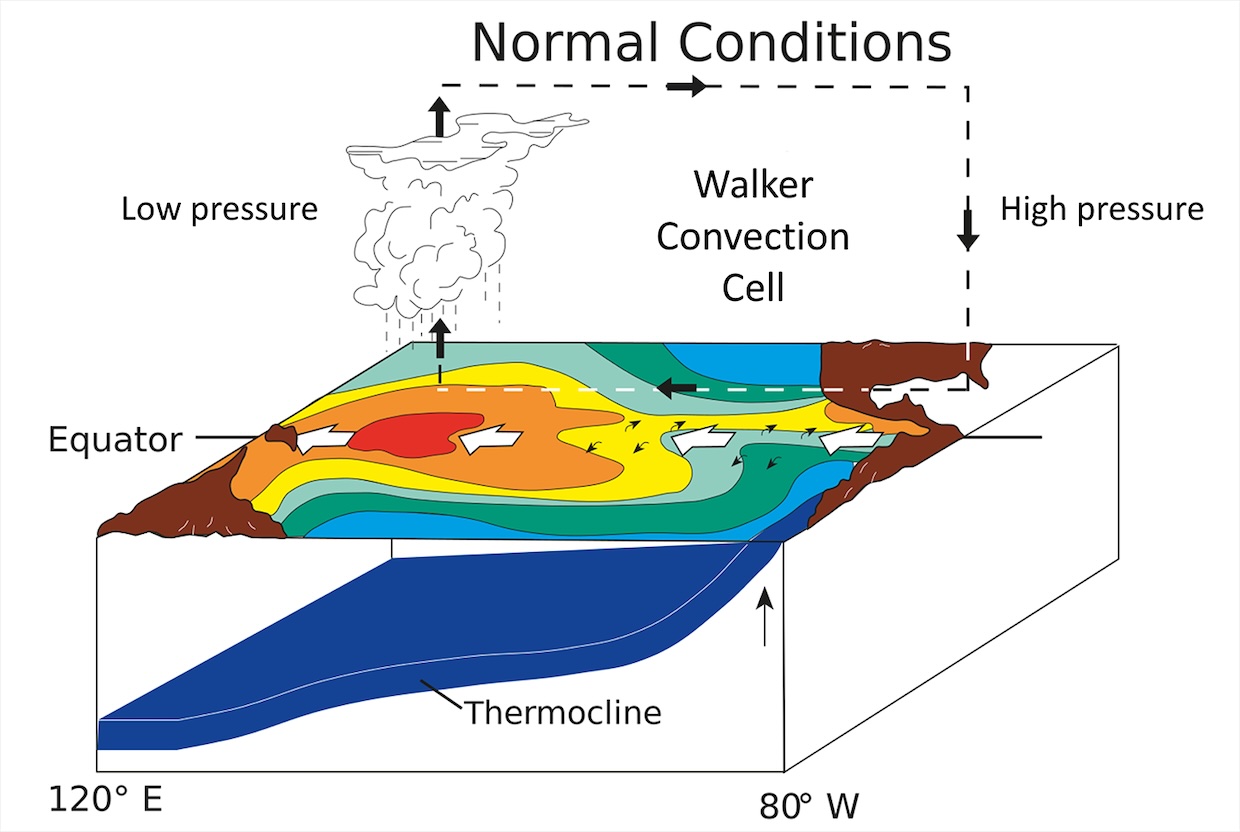
Well, as the pharaoh’s charioteers learned the hard way several millennia ago, holes in water don’t ever last for very long. In this case, because the winds were relentlessly blowing the top of the ocean toward Oceania, the only place that the water needed to fill the hole could come from was deeper levels of the ocean.
These upwelling currents did two things: they tried to fill the hole and bring the surface of the sea back to level; and along the way they brought with them nutrients from lower down near the sea floor. This injection of a rich food source into near-surface waters supported a robust fish population, which kept the fisherfolk and their families alive, fat, and sassy.

Sadly, every few years the winds would reverse, now blowing from west to east. As a result, there was no longer a hole left in the water off Peru, the upwelling currents bringing the nutrients were blocked, which in turn would stop feeding the fish populations. As a result, the fish moved away. This took food off the tables of the fishermen, and left their wives and kids crying for their supper.
(It may be instructive to note at this time that wind blows from areas of higher pressure to areas of lower pressure, and the pressure of the atmosphere is directly related to the temperature of whatever it is over the top of… in this case the ocean. So therefore, as the temperature of the ocean changes, so does the direction of the wind — “Post hoc ergo propter hoc” as Poppy would once again remind us. Maybe ENSO is partially involved with the changing climate after all. Just sayin’.)
Anyway, after an indeterminate amount of time, the global wind patterns would reassert themselves, again blowing from east to west. This in turn re-dug the hole in the water off Peru, which could then be filled by nutrient-rich upwelling currents, which again started feeding the fish, reestablishing the bountiful fish harvest, and filling hungry bellies. The El Niño phase of the ENSO cycle was over… until next time.

But, like any good cycle, that’s not the end. Sometimes the winds will blow even more strongly from east to west. This portion of ENSO has been called La Niña, and can also set up some pretty significant global climatic changes. But again, just for a short span of time, measured in months or a year or so at the most before the wind patterns again revert back to a more “normal” state, and the cycle begins anew.
Such is born the El Niño Southern Oscillation which — in broad, possibly over-simplified terms — acts very much like a pendulum. Sure, there will be deviations and disruptions in any attempt to paint such a regular pattern, but it seems to mostly hold: normal, El Niño, normal, La Niña, normal, El Niño, and so on.
Marker Bed, my novel and geology primer is now available on Amazon. With heroes and a villain — and Xoix of course — the story takes place 300,000,000 years from now and documents the recognition of humanity in the fossil record. It is a must read for anyone who loves the earth and hopes that it will survive our tender mercies. If you haven’t already obtained your copy, I encourage you to do so now. Click here to go to the Amazon website and lock in your copy.
Much is made about the effects that the El Niño Southern Oscillation cycle has on global weather and climatic patterns, but as I said at the top, it is not my intent to delve into them in this post. We’ll save that for later.
Many disparate sources are predicting a “Super El Niño” for this coming year. Newsweek published “New Super El Niño Maps Show Potential Rainfall, Temperatures Across US” (21 August 2026) which includes a generalized projection for the U.S., along with a series of maps. What it didn’t include is any clearly-stated reasoning for attaching the “Super” adjective to this El Niño season, other than suggesting that warmer ocean temperatures may play a role in any El Niño phase.
Even Fox Weather is getting in on the fun. Their recent article (18 August 2026) titled “Brewing Super El Niño expected to be strongest anyone alive on the planet has ever experienced” is certainly another title that falls into the “clickbait” category, and one could reasonably expect that it would cover the predicted event in detail (I know I did, although maybe these data are hidden in one of the linked articles). But the main article includes no discussion regarding the use of “Super” in the title, any discussion of why this one is going to be super, and — while it also links the warmer part of the ENSO cycle to ocean temperatures — the term “Climate Change” is nowhere to be found.
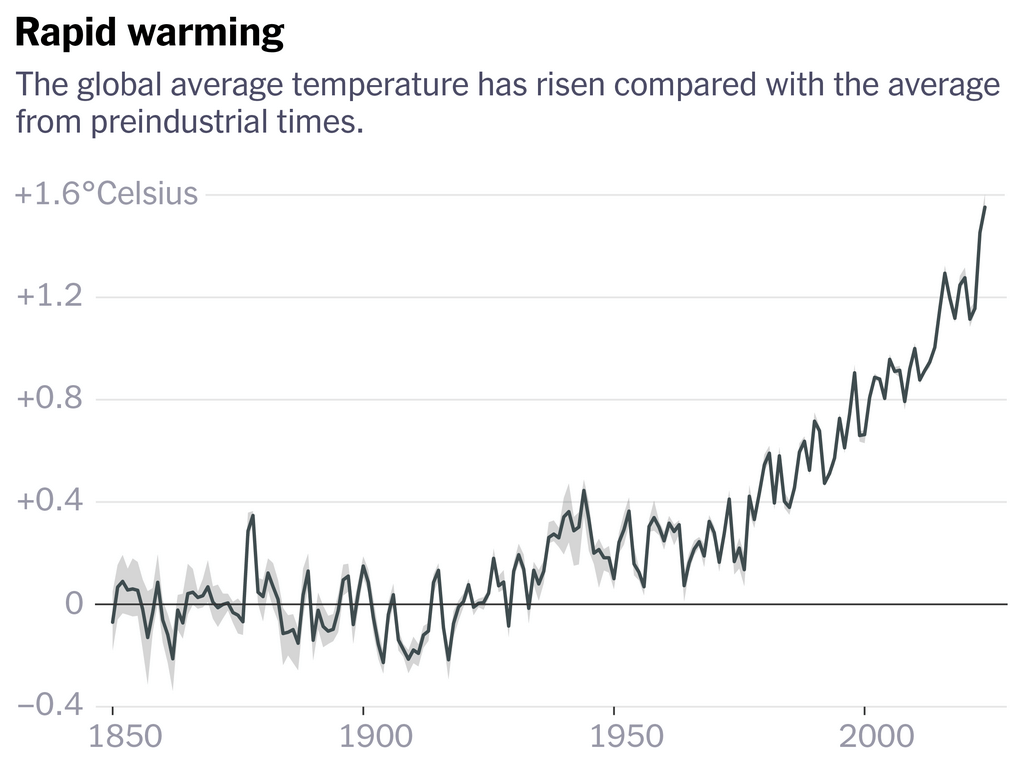
But… Climate Change is becoming increasingly proposed by many — scientists and non-scientists alike — as the culprit for much of the severity of the wild climatic shifts, and it’s pretty tough to claim that increased carbon emissions — at least if you credit the above graph — haven’t had an effect on average temperatures across the globe.
I mean, really: if ENSO is all about surface temperatures in the ocean, anything that affects them has to be suspect and worth at least a smidgen of respectful consideration! Whether you want to talk about increased rainfall, widespread and ongoing drought, massive heat waves, or whatever, the warming climate, if not completely responsible, should at least be proposed as a contributing factor.
A Request… Please hit the Subscribe button and sign up for updates to this blog. It costs you nothing and gives me nothing, other than a bit of emotional validation for my efforts. What you will get — along with my undying gratitude — are email notifications when new posts are published. Please subscribe now. Thanks!
If you’ve been following my previous posts you are probably already familiar with my thoughts regarding the earth’s changing climate, so I don’t think I need to go too deeply into my personal feelings about that at this time (click here for an index of posts regarding Climate Change). What I will say, however, is that any who claim the ENSO cycle is entirely the result of climate change — just like those who claim that the warming climate is entirely the result of human excesses — would peg the classroom’s Bozometer (pronounced bo-ZOM-eter).

So yeah. Is human-exacerbated climate change contributing to the severity of ENSO? Most likely! But it’s not the sole cause.


