Nature Abhors a Vacuum
I pulled into the post office a couple days ago and there it was — yet another square-backed vehicle with a dirty rear window. The driver was just getting out (she was from California but we shouldn’t hold that against her — although we have better dirt here in Oregon).
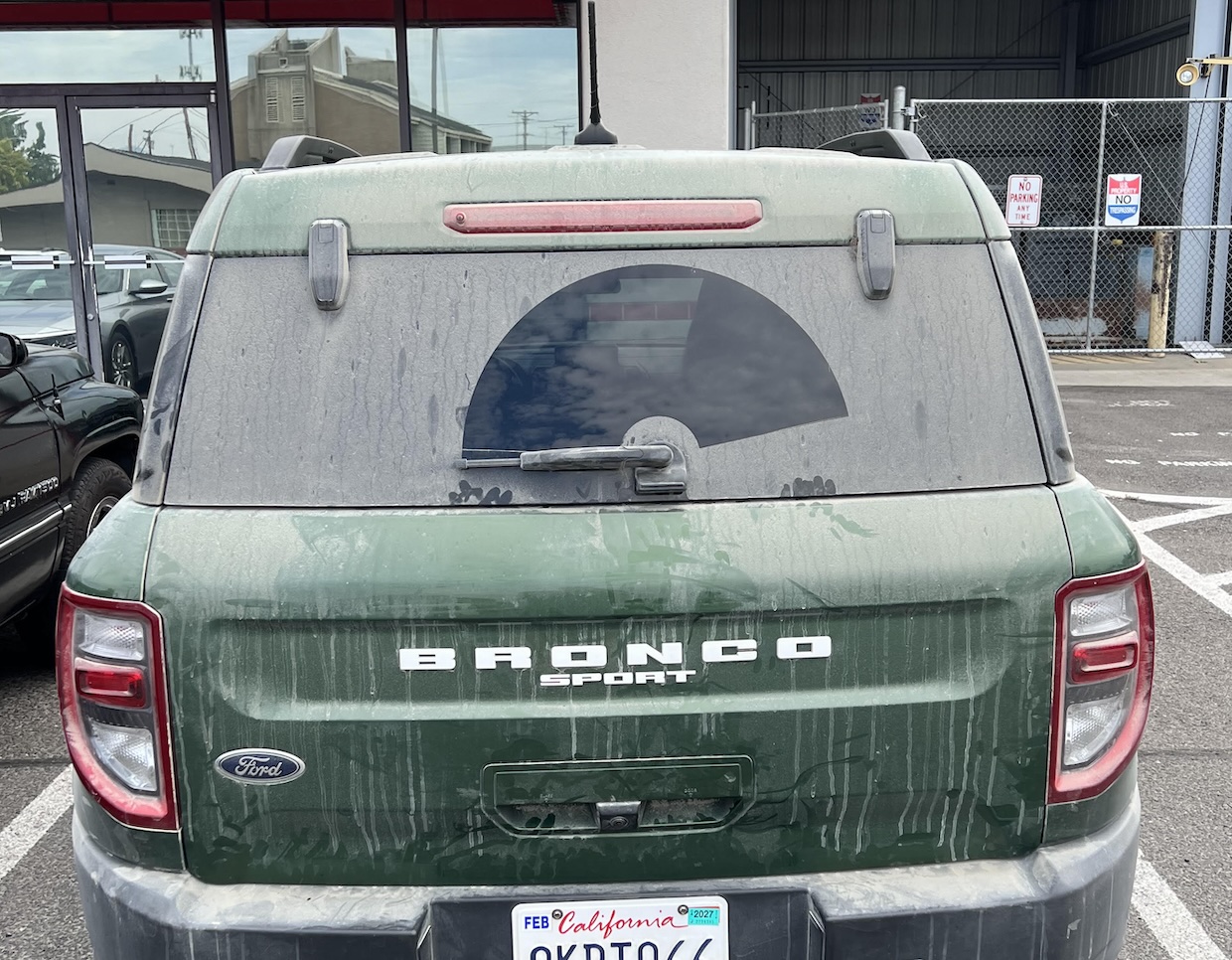
I asked whether she minded if I took a picture of the back of her Ford (FORD: “Found On Road Dead”, said the Chevy driver). I told her it would be featured in a blog post I’d been meaning to write, and that she’d be famous within a week or so. “Sure, no problem,” she bubbled.
Obviously feeling a need to explain, she went on to bemoan her Bronco’s constantly filthy rear tailgate. “I live on a dirt road and the back of my car always seems to be covered in dust.” I suggested that the Powers That Be probably weren’t targeting her specifically, and not to sweat her karma. “This is an all-too-common issue — that’s what my post is going to be about.” I handed her a card with my blog’s URL (and a link to Marker Bed), wished her a pleasant, dust-free afternoon, and boogied into the Post Office.
Marker Bed, my novel and geology primer is now available on Amazon. With heroes and a villain — and Xoix of course — the story takes place 300,000,000 years from now and documents the recognition of humanity in the fossil record. It is a must read for anyone who loves the earth and hopes that it will survive our tender mercies. If you haven’t already obtained your copy, I encourage you to do so now. Click here to go to the Amazon website and lock in your copy.
We’ve all seen it: the filthy rear panel of a big 18-wheel tractor-trailer rig, with “WASH ME” written in the dust by some public-spirited soul.

If you’re anything like me, you may have wondered why so many truck and SUV drivers never wash their rigs. I mean, really, where is the pride?
But maybe they do, and the rear panels of square-backed vehicles just attract dirt. Some sort of magic dust magnet or something. Okay, probably not. But there is a valid and simple reason, and as usual, while science makes it easy, the “official” explanation can get a bit verbose:
The rear panel (tailgate) of a truck gets dirty due to aerodynamics. As you drive, the air flowing over the roof and sides separates sharply at the back, creating a low-pressure pocket (vacuum) behind the truck. This vacuum creates a swirling vortex that sucks up road spray and dust, depositing it directly onto the tailgate.
(If you read and unpack this carefully, you may also come to the inescapable conclusion that some of it doesn’t make any sense whatsoever…)
Anyway, a shorter, hopefully more simplified version may help: As the vehicle bullies its way through the atmosphere, the air splits at the front of the rolling stock (NOT the back) and flows around the mass (much like Moses parting the Red Sea). When the air comes back together at the back of the rig it brings with it dust and dirt (like the Red Sea likely brought fish along when it engulfed the Pharaohs charioteers — like the old saying recommends: “Eat fish and die” … or something like that).
That sounds good as far as it goes, but I’m pretty sure that there’s one more contributing factor that the official explanation failed to consider.

As we learned from Aristotle over two thousand years ago, nature abhors a vacuum (“horror vacui” in his words). Consider a balloon that’s full of air and just taking up space. There’s no atmosphere where the balloon is, but if the balloon pops the blockage is gone, and now there’s a hole — a vacuum — in the air where the balloon used to be.
What happens next? Well, we hear a noise: initially from the popping of the balloon and the release of its contained high-pressure air, but after that from the surrounding air rushing back in to fill the void. This all occurs very quickly so it seems like a single event, but really there are two separate and distinct things that happen, and both involve air molecules moving at a very high rate of speed.
The same thing happens as a truck or a car is driving down the highway. The vehicle displaces the atmosphere, so there is no air where the truck is. But as the vehicle continues down the road the vacuum moves along with it, there is a hole left in the atmosphere behind the rig as it moves away, and the surrounding air rushes in to fill the void.
It works just like the balloon, although without the initial popping sound as the air from inside the balloon is released (and the other sound(s) are masked by all the noises that accompany a truck as it barrels along the roadway).

The end result is obvious for any vehicle rolling down the highway and dragging its own personal vacuum along with it: there is a constant flow of air directly towards the back of the truck as the vacuum is filled. This airflow brings along with it the dust and dirt and other loose goodies that attach themselves to the rear tailgate of the car or truck.
The same thing happens in the bed of a pick-up. You may have noticed if you drive around very much that loose leaves and pieces of dirt and whatever pile up in the bed of the truck up against the back of the cab. This accumulation of crud is due to the exact same reason as the dust and dirt on the back tailgate.
Seems to me that a two-point free question coupon should go to aerodynamics.
So, the next time you see the back of a square-backed vehicle and are tempted to write “WASH ME” in the dust, take a chill pill and blame it on physics. It’s not necessarily the driver’s fault.


Also Ford: “Fix Or Repair Daily”.
MOPAR, baby!
Interesting info, BTW.
Good to hear from you. Yep, that’s the other one I remember from the wayward days of my youth. Could never seem to find a clever ditty that the Ford aficionados could use against Chevy, however.